Minnesota EIDBI Agencies Are Being Shut Down, Raided, and Charged. Here Is What Legitimate Agencies Need to Know.
Federal agents raided Twin Cities autism centers in April 2026. Over 760 agencies have been terminated. The DOJ called it the largest Medicaid autism fraud case ever charged. Here is what is happening and what legitimate EIDBI agencies need to do right now.
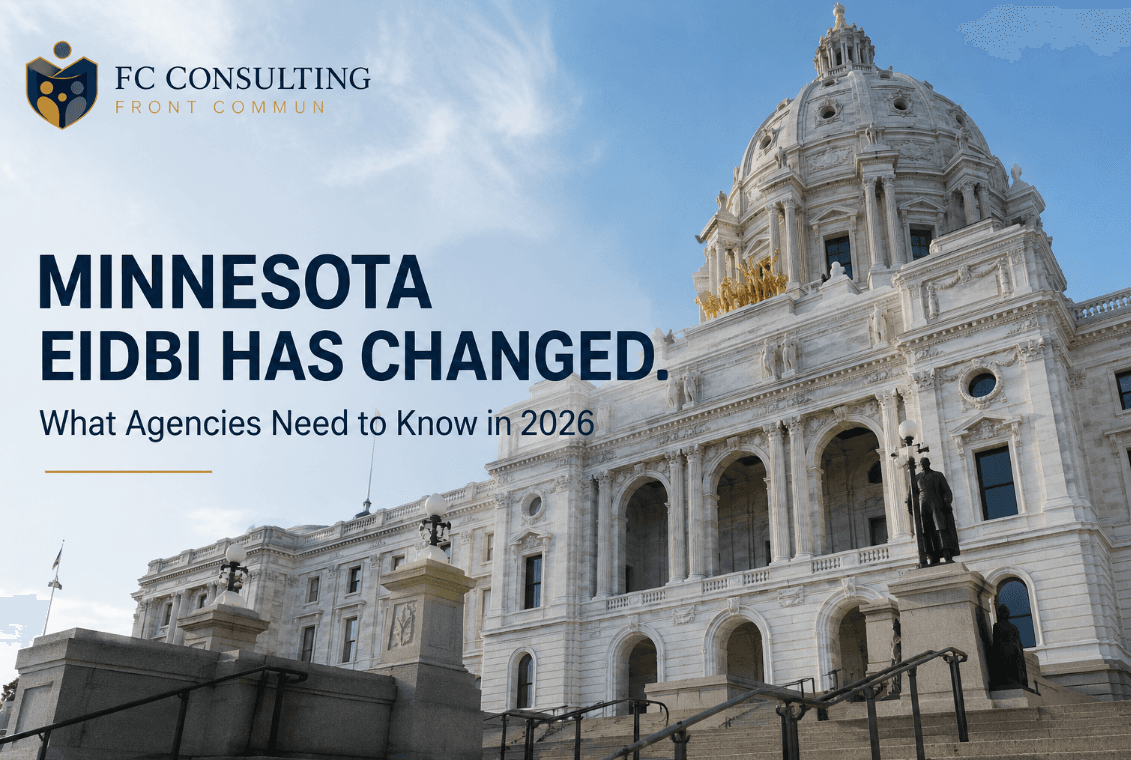
On April 28, 2026, FBI agents, Homeland Security Investigations, and the U.S. Attorney's Office executed search warrants at multiple autism centers across the Twin Cities. The raids were not an isolated event — they were the visible tip of a years-long federal and state investigation into what authorities have called the largest Medicaid autism fraud case ever prosecuted by the Department of Justice.
By May 2026, fifteen defendants had been charged in connection with over $90 million in fraudulent EIDBI billings. The schemes described in federal charging documents were brazen — kickbacks paid to parents who brought children to autism centers, children diagnosed with autism regardless of medical necessity, and millions of dollars billed for services that were never delivered.
For legitimate EIDBI agencies in Minnesota, this is not someone else's problem. The crackdown has reshaped the entire program, and the agencies that survive will be the ones that understood what was coming and got ahead of it.
How a $1 Million Program Became a $400 Million Fraud Magnet
In 2017, Minnesota became one of the first states in the country to offer Medicaid coverage for EIDBI services. In its first year, EIDBI claims totaled just over $600,000. By 2025, that figure had grown to over $400 million — a more than 34,000 percent increase in eight years.
The program's rapid growth attracted a wave of fraudulent providers. Agencies with no real clinical infrastructure enrolled in MHCP, hired contractors instead of employees, operated out of empty addresses, and billed for services that either never happened or were clinically unjustified. DHS, according to a March 2026 report from the Office of the Legislative Auditor, had the legal authority to stop payments to suspected fraudulent providers far earlier than it did — but failed to act.
EIDBI claims skyrocketed from $1 million in 2017 to over $343 million by 2024. The Office of the Legislative Auditor found that DHS had authority to cut off payments to suspected fraudsters and failed to do so.
What the Crackdown Looks Like on the Ground
Since October 2024, DHS has conducted 444 unannounced site visits to EIDBI providers across Minnesota. Every single EIDBI agency in the state has been reclassified as high-risk. In October 2025, DHS terminated 761 agencies for inactivity in a single action. Between October 2025 and March 2026, an additional 18,109 providers across high-risk Medicaid programs were terminated as part of a federal Corrective Action Plan with the Centers for Medicare and Medicaid Services.
DHS also implemented enhanced prepayment review of all EIDBI fee-for-service claims in December 2025 — meaning every claim is now subject to additional scrutiny before payment is released. Payment withholds have more than doubled compared to prior years.
The May 31, 2026 provisional license deadline has passed. Every EIDBI agency in Minnesota was required to submit a provisional license application by this date. Agencies that did not submit are required by law to cease operations and will be disenrolled from Minnesota Health Care Programs. If your agency has not submitted, contact DHS at eidbi.licensing.dhs@state.mn.us immediately.
What Separates the Agencies Still Standing
The agencies that have come through this environment intact share a common profile. They employ their staff as W-2 workers. They maintain clean, current documentation — ITPs on the right forms, supervision logs that match billing records, background studies cleared for every person on the roster. Their physical locations are real, operational, and match what is on file with DHS. When an inspector walks through the door unannounced, they can produce every required document within minutes.
These agencies are not just surviving the crackdown — they are in a stronger competitive position than they have ever been. With hundreds of fraudulent agencies removed from the program, the legitimate providers that remain are serving a growing caseload of families who need real, quality care.
What Your Agency Needs to Have in Order Right Now
- Provisional license submitted. Applications were due May 31, 2026 through the DHS Provider Hub. If yours was not submitted, contact DHS licensing today at eidbi.licensing.dhs@state.mn.us.
- All providers on W-2. Level I, II, III, and QSP providers must be employees of your agency — not independent contractors. This has been the law since 2025 and is verified during every site visit.
- NETStudy 2.0 roster fully cleared. Every owner, operator, employee, and volunteer must have a completed background study with an eligible or set-aside result on file before providing services.
- QSP supervision documented. As of January 1, 2026, QSPs must provide at least one hour of clinical supervision per 16 hours of direct treatment, with monthly observation required for every recipient.
- ITPs current and on the right form. All Individual Treatment Plans must use the updated DHS-7109 form and include the supervision frequency section.
- No billing without a service authorization. Every claim must have a valid DHS-approved service authorization on file before services are delivered and billed.
Need Help Getting Into Compliance?
FC Consulting works with Minnesota EIDBI agencies on compliance readiness, DHS site visit preparation, documentation reviews, provisional license support, and BCBA and QSP staffing. If your agency is navigating any of the issues described in this article, we can help.
Reach out through our contact page. We respond same day.
This article was prepared by FC Consulting based on publicly available information from the Minnesota Department of Human Services, the U.S. Department of Justice, and the Office of the Legislative Auditor, current as of June 2026. This is not legal advice.
Need help applying this?
Talk with FC Consulting about your agency's next step.
We can help with compliance, licensing, operations, workforce support, and provider readiness.
Contact us